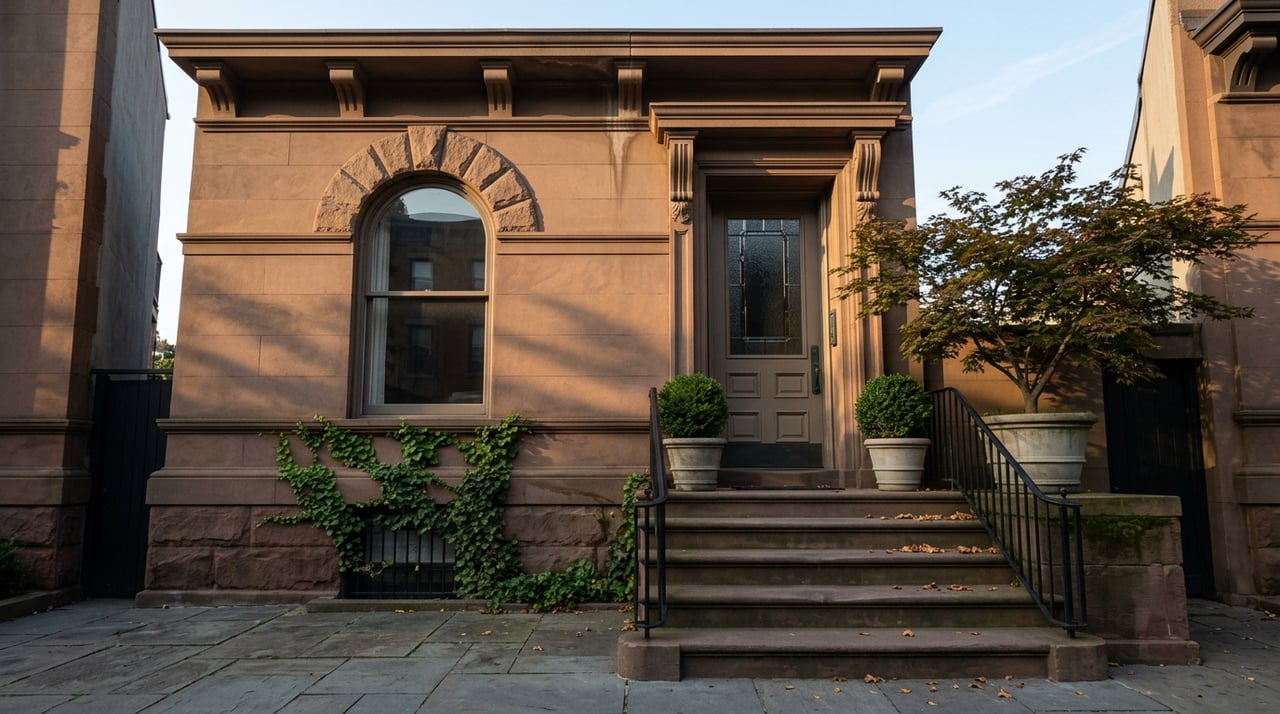
"The arts should be accessible to everyone." That line shows up in the National Arts Club's own social posts, part of a season recap that otherwise reads like any nonprofit's fundraising appeal. It reads like boilerplate until you place it against the building it describes: a landmarked brownstone behind Gramercy Park's wrought iron fence, on the one block in Manhattan where the park itself is locked to anyone without a resident's key.
Most people walking a lap around Gramercy Park assume the mansion at 15 Gramercy Park South follows the same rule as the grass and benches on the other side of that fence. It doesn't. The National Arts Club is a private membership club, and its front door is open to the public most days of the week, free of charge, no key required.
What's Actually Open This Month
The club's 2026-27 season opens September 10, which means the calendar that's been quiet since the season wrapped in June is filling back in right now.
- Everett Raymond Kinstler: Celebrating 100 Years, an exhibition on view September 11 through October 8, marking the centennial of the club's longtime portrait painter
- James Díaz, a Grammy-nominated composer and one of the club's Artist Fellows, performs September 14 at 7 p.m.
- FashionSpeak Fridays: Fashion of the Gilded Age, a lecture with Raissa Bretaña, author of a book on the same subject, walking through silhouettes from 1870 to 1910, on Friday, September 25
All three are free. The exhibition galleries keep public hours Monday through Friday from 9 a.m. to 3 p.m. and weekends from 10 a.m. to 4 p.m., which means a Gramercy resident can walk in on a weekday lunch break the same way they'd duck into a coffee shop.
The Key You Don't Need
Membership at the National Arts Club comes with a genuine perk that has nothing to do with art: access to a private Gramercy Park key, the same kind that unlocks the gate to the park across the street. It's one of the more talked-about lines on the club's own history page, and it fits the mythology of Gramercy Park as a place you either belong to or don't.
But the key only gets you into a park. What's free to the public gets you into a building holding a permanent collection of more than 700 works, much of it donated directly by member artists over more than a century, inside a Victorian Gothic Revival mansion with stained glass windows and velvet-covered walls that predates most of the co-ops around it. The Tilden House was designated a New York City landmark in 1966 and a National Historic Landmark a decade later, and it sits inside the Gramercy Park Historic District, which means the building itself is protected the same way the park's iron fence is.
In practical terms, the resident without a park key is often seeing more of Gramercy Park's history than the resident with one.
Why a Private Club Ended Up Running a Public Arts Calendar
The arrangement makes more sense once you know how the club started. It was founded in 1898 by Charles DeKay, an art and literary critic at the New York Times, with a stated goal of building public interest in the arts rather than gatekeeping it. The club moved into the Tilden House in 1906, taking over the former home of Samuel Tilden, a New York governor, and has stayed there since.
Its member rolls over the twentieth century read like a syllabus: painters Robert Henri, Frederic Remington and William Merritt Chase, sculptors Augustus Saint-Gaudens and Daniel Chester French, and writers including Mark Twain and W.H. Auden. The club hasn't always used that history gracefully. In 1905 it exhibited a sculpture it billed as an ancient Roman Aphrodite, which critics quickly identified as a much newer fake. In 1922 a George Bellows nude painting scandalized the same crowd that now runs Instagram accounts announcing free Friday lectures.
What's held steady is the free-to-the-public structure, which the club says now runs to more than 150 programs a year for roughly 25,000 visitors, spanning exhibitions, a live jazz series produced with the National Jazz Museum of Harlem, and lecture nights like FashionSpeak Fridays. That's a public arts calendar on the scale of a small nonprofit institution, operating out of a members-only clubhouse most of Gramercy walks past without a second look.
What This Means for an Ordinary Week
None of this requires planning. The gallery hours overlap with a workday, which makes the Kinstler exhibition a lunch-hour stop rather than a weekend commitment. The James Díaz performance on September 14 and the FashionSpeak lecture on September 25 both land on evenings a Gramercy resident is probably already walking past the park anyway, on the way to dinner on Irving Place or a drink somewhere off Third Avenue.
The building doesn't advertise like a museum. There's no ticketing site pushing notifications, no line around the block. The calendar lives on the club's own site and its event listings, updated the way a community bulletin board gets updated, which is part of why so many people who live two blocks away have never been inside. The free part of Gramercy Park's most exclusive-looking address turns out to be the easiest plan in the neighborhood to make.
If you're the kind of Gramercy resident who already treats the park's private key as background noise, walking through a different door at the same address costs nothing and takes less time than deciding where to eat.
Darya Goldstein and the Hoffman Team spend a lot of time in buildings like this one, the ones with more history behind the facade than the listing photos ever show. If you're curious what a Gramercy address like this one is actually worth, or just want a local read on the block, Darya Goldstein is always glad to talk it through. Let's Connect.